Top Extrusion Crosshead Manufacturers (2027) and How to Choose a Crosshead
Who makes extrusion crossheads for wire, cable and tubing in 2027, the main crosshead types (fixed-centre, manual-centre, in-line, multi-layer), and what to check before you buy.
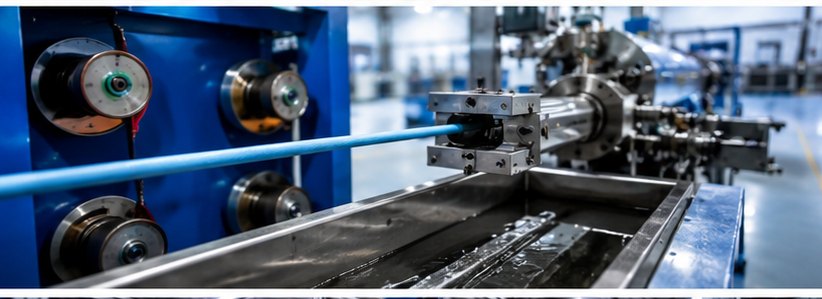
The extrusion crosshead is the part of a cable or tubing line that decides whether the insulation ends up concentric, clean and the right thickness. You can pair a good crosshead with an average extruder and get good cable; the reverse rarely works. This guide covers the extrusion crosshead manufacturers worth knowing in 2027, the main crosshead types, and how to choose one.
If you are new to the subject, start with our explainer on what a crosshead does in cable extrusion.
Extrusion crosshead types at a glance
| Type | How the wall is centred | Typical use |
|---|---|---|
| Fixed-centre | Tooling is machined to centre itself; no adjustment | High-volume products, fast changeovers |
| Manual (adjustable) centre | Operator centres with adjusting bolts | Mixed products, older lines, fine control |
| In-line head | Melt flows straight through, product runs in line with the extruder | Tubing, some jacketing |
| Multi-layer / co-extrusion | Two or more extruders feed one head | Skin layers, dual and triple-layer insulation |
Fixed-centre heads cut setup time and operator dependence. Manual-centre heads take more skill but give the operator direct control. That is useful when a line runs many different sizes. Either way the goal is the same: an even wall around the conductor, which is what concentricity and eccentricity measure.
1. Guill Tool & Engineering
Guill, based in Rhode Island, USA, has designed and built extrusion tooling since 1962. Its wire and cable range covers crossheads, tips and dies and wire coating equipment, including in-line multi-layer heads, co-extrusion designs and single-point concentricity adjustment. It is one of the most respected crosshead specialists, especially for multi-layer and medical tubing work. Guill sells tooling rather than complete lines, so you pair it with your own extruder and downstream equipment.
2. Maillefer
Maillefer supplies crossheads for wire and cable production lines, designed around its own extruders and process know-how. That makes them a natural choice if you already run Maillefer equipment.
3. Rosendahl Nextrom
Rosendahl Nextrom builds extrusion equipment as part of its complete cable and wire production lines. Like Maillefer, its heads are most often bought with the line rather than as a separate tooling purchase.
4. Troester
Troester supplies complete extrusion systems for the cable industry, with the heads engineered as part of the system. It is usually considered for larger, more demanding insulation projects rather than as a standalone head supplier.
5. Sai Extrumech
Sai Extrumech, an Indian extrusion machinery builder, makes fixed-centre and manual-centre crossheads and in-line heads for wire, cable and tubing, along with skin-layer heads, tips, dies and replacement tooling. Its heads are mainly used on lines in India and nearby markets. It is a practical option when you need a head built to a specific conductor range at a lower cost. The trade-off is that its documentation and service network are regional rather than global.
How to choose an extrusion crosshead
- Product and size range. Specify the conductor sizes and finished ODs you need. A head that covers too wide a range compromises at both ends.
- Centering method. Fixed-centre for high-volume products and quick changeovers; manual-centre if you run many sizes and have skilled operators.
- Flow channel design. Ask how the head avoids dead spots. Stagnant melt degrades and turns up as black specks and spark-test faults.
- Layers. Single, dual or triple layer. Adding a skin or stripe layer later usually means a new head, so plan ahead.
- Heating and temperature control. Enough heater capacity with even distribution; uneven head temperature causes uneven walls.
- Extruder fit. Check flange, mounting and melt connection to your extruder.
- Tooling and spares. Tips and dies wear and get damaged. Confirm cost and lead time for replacements before you buy the head.
Frequently asked questions
What is an extrusion crosshead?
An extrusion crosshead turns molten polymer from the extruder through 90 degrees and distributes it evenly around a conductor or mandrel passing through its centre, forming the insulation, jacket or tube wall.
What is the difference between a fixed-centre and a manual-centre crosshead?
A fixed-centre crosshead centres the tooling by design, with no adjustment, so setup is fast and repeatable. A manual-centre crosshead lets the operator adjust centering with bolts, which gives more control but depends more on operator skill.
Who makes extrusion crossheads?
Well-known extrusion crosshead manufacturers include Guill Tool & Engineering, Maillefer, Rosendahl Nextrom and Troester, along with regional builders such as Sai Extrumech in India.
Can I fit a new crosshead to my existing extruder?
Usually, yes, as long as the mounting and melt connection match or an adapter is made. Many plants upgrade heads to improve concentricity or add layers without replacing the extruder.
The bottom line
For multi-layer and precision work, specialist tooling makers such as Guill set the standard. If you are buying a complete line, the line builder’s own heads are the natural choice. For a cost-effective replacement or custom head, regional builders are worth a quote. In every case, judge a crosshead by the concentricity it delivers on your product, not by its spec sheet.
Background reading: plastic extrusion process overview.