Concentricity and Eccentricity in Cable Insulation: What They Mean and How They're Controlled
Why keeping the conductor centred in its insulation matters for safety and cost, how eccentricity is measured on a running line, and what controls it during extrusion.
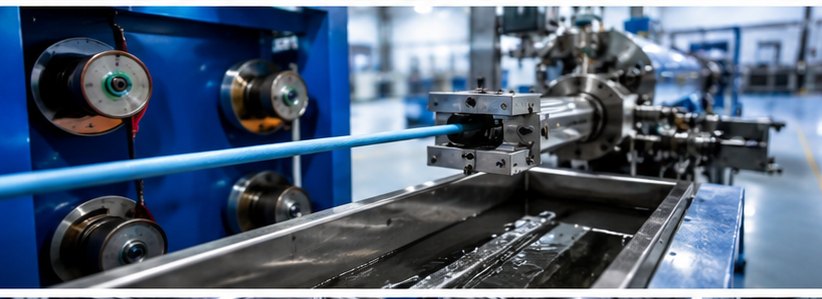
Of all the quality measures on a cable line, concentricity is the one that most directly ties production to both safety and cost. It describes how well-centred the conductor sits inside its insulation — and when it drifts off-centre, the consequences are immediate and expensive. This article explains the concept, why it matters so much, and how a line keeps it under control.
Concentricity vs eccentricity
The two terms describe the same geometry from opposite ends:
- Concentricity is how centred the conductor is within the insulation — high is good.
- Eccentricity is how off-centre it is — the deviation from perfect centring.
If insulation were perfectly concentric, the wall thickness would be identical all the way around the conductor. In reality there is always some variation; the job of the line is to keep it within tight limits.
Why it matters so much
Poor concentricity hurts on two fronts at once:
- Electrical safety. The thinnest point of the wall is the weakest point of the insulation. If the conductor drifts to one side, that thin side has reduced dielectric strength and becomes the likely site of breakdown under voltage. A cable is only as good as its thinnest wall.
- Material cost. To guarantee the minimum wall on the thin side meets specification, a poorly-centred process has to run the average wall thicker — which means extra polymer on the thick side, wasted on every metre of every reel. Over a production run that is a large, invisible cost.
So concentricity is simultaneously a safety parameter and an economic one, which is why it gets so much attention. The principle and its consequences are explained well in this overview of how concentricity is controlled in wire and cable insulation.
Where eccentricity comes from
Off-centre insulation usually traces back to a handful of causes:
- Crosshead centering. The conductor may not be running through the exact centre of the die. Traditional crossheads are centred with adjusting bolts; self-centering tooling reduces the problem.
- Uneven melt flow. If polymer does not arrive evenly around the full circumference — often due to flow-channel design or a temperature imbalance — one side builds up thicker.
- Wire position instability. Vibration, poor pay-off tension or a wandering conductor shifts the wire within the die.
- Temperature asymmetry across the crosshead, changing viscosity on one side.
How it is measured
Modern lines measure eccentricity continuously and without contact:
- X-ray or ultrasonic wall gauges sit just after the crosshead or cooling trough and read wall thickness at multiple points around the circumference, computing eccentricity in real time.
- These systems display the conductor’s position within the insulation, often as a live cross-section, so an operator can see immediately which way the wire has drifted.
Continuous measurement is what turns concentricity from a lab check on cut samples into a live process that is corrected as it runs.
How it is controlled
Once eccentricity is measured, it is managed by:
- Crosshead adjustment — nudging the die/tip centering (manually on older tooling, automatically on lines with motorised or self-centering heads that respond to the gauge).
- Melt uniformity — a streamlined, well-balanced crosshead flow path and even temperature so polymer arrives evenly.
- Stable wire handling — consistent pay-off tension, straightening and pre-heating so the conductor runs true and central.
- Closed-loop feedback — on advanced lines, the wall gauge feeds corrections back to the centering system so the process self-corrects.
Takeaway
Concentricity is where cable quality and cost meet. A well-centred conductor means every part of the wall meets its minimum, the cable is safe at voltage, and no polymer is wasted carrying an over-thick side. Achieving it comes down to three things working together: a good crosshead, an even melt, and stable wire handling — all watched over by continuous, non-contact measurement.