PVC vs XLPE vs PE: Choosing the Insulation Material for Cable Extrusion
A practical comparison of PVC, PE and XLPE cable insulation — electrical and thermal properties, where each is used, and how the choice changes your extrusion setup.
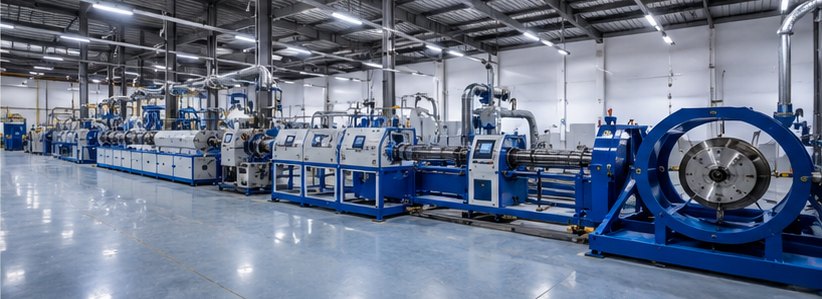
The insulation compound is the heart of a cable’s performance, and it also dictates a good deal about how the extrusion line must be built and run. For most wire and cable made in India, the decision comes down to three families: PVC, PE and XLPE. Each has a clear home, and choosing correctly is as much an engineering decision as a commercial one.
The three families at a glance
| Material | Max continuous temp | Typical use | Process note |
|---|---|---|---|
| PVC | ~70 °C | Building wire, LV control, sheathing | Heat- and shear-sensitive |
| PE (thermoplastic) | ~70–75 °C | Communication, LV, some LV power | Needs clean melt, good cooling |
| XLPE (cross-linked) | ~90 °C (higher short-circuit) | LV/MV/HV power cables | Requires a curing stage |
PVC
Polyvinyl chloride is the most widely used insulation and sheathing material for low-voltage and building applications. It is inexpensive, flame-retardant by formulation, flexible and easy to colour. Electrically it is adequate for low voltage rather than exceptional.
From a processing standpoint, PVC is heat- and shear-sensitive: push it too hard or too hot and it degrades, discolours and can release corrosive by-products. That makes gentle, well-controlled screw and barrel behaviour essential — the compound wants to be melted smoothly, not beaten.
PE (polyethylene)
Thermoplastic polyethylene has excellent dielectric properties — low permittivity and low loss — which is why it dominates communication cables and features in many power applications. It is cleaner electrically than PVC but is thermoplastic, so its temperature rating is limited and it softens with heat.
Processing PE well means a thorough, homogeneous melt and effective, graduated cooling, since the insulation must solidify uniformly to keep its electrical quality and dimensions.
XLPE (cross-linked polyethylene)
XLPE takes polyethylene and chemically cross-links it, converting it from a thermoplastic into a thermoset. The payoff is a big jump in temperature capability — around 90 °C continuous, with strong short-circuit performance — plus better mechanical and ageing behaviour. This is why XLPE is the standard for modern LV, MV and HV power cables.
The catch is process complexity: cross-linking requires a curing stage, most commonly a CCV (Catenary Continuous Vulcanisation) line where the extruded core passes through a heated, pressurised tube to cure. That is a more demanding and capital-intensive line than a simple thermoplastic extruder.
How the material changes your line
The insulation choice ripples through the whole setup:
- Screw and barrel geometry has to suit the polymer — a screw tuned for gentle PVC is not ideal for PE, and vice versa. Getting this pairing right is central to output and quality, and worth planning around from the start; matching the screw and barrel to the polymer is one of the first decisions when a line is specified.
- Temperature control is tighter for shear-sensitive PVC and for cure-dependent XLPE.
- Downstream differs sharply: thermoplastics need cooling troughs, while XLPE needs a curing line before cooling.
- Cleanliness matters more as voltage rises — for MV/HV XLPE, contamination control becomes critical.
Choosing for your product
Work from the cable’s rating:
- Low-voltage building wire, control, flexibles → PVC, for cost and flame performance.
- Communication or where dielectric quality leads → PE.
- Power cables needing higher temperature and longevity → XLPE, accepting the curing-line investment.
For the broader standards context, bodies such as the IEC define the material and testing requirements that ultimately govern these choices in India and globally.
Takeaway
PVC, PE and XLPE are not interchangeable — they occupy different voltage and temperature bands, and each imposes its own demands on the extrusion line, from screw design to whether you need a curing stage at all. Decide the cable’s rating first; the right insulation, and the right line to make it, follow from there.