Conductor Stranding and Bunching: What Happens Before the Extruder
Solid, stranded, bunched and compacted conductors explained: IEC 60228 classes, concentric vs bunched construction, lay length, and why conductor quality matters to the extrusion line.
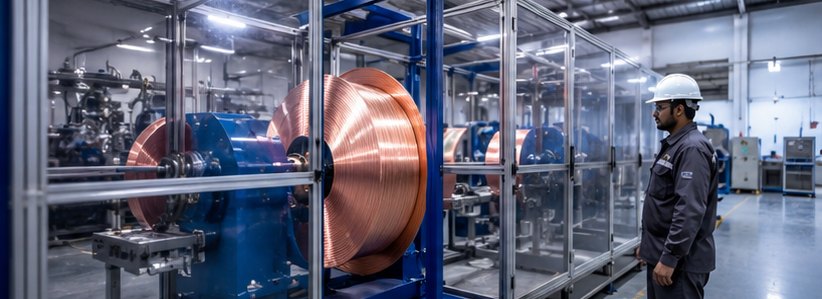
Most discussion of cable manufacturing focuses on the extruder and the insulation. But the conductor arrives at the extruder already made, and how it was made decides a lot: how flexible the finished cable is, how round it is, how well the insulation centres around it, and even how many faults the spark tester finds. This article covers the conductor side, from solid wire through stranded, bunched and compacted constructions.
Conductor classes
The international reference for conductors is IEC 60228, which groups them into classes by construction and flexibility:
- Class 1: solid. A single wire. Stiff, cheap and easy to insulate, used for small building wire where the cable is installed once and left.
- Class 2: stranded. Several wires twisted together. More flexible than solid, used for larger building wire and most power cables.
- Class 5: flexible. Many fine wires, usually bunched. Used for flexible cords and equipment wiring.
- Class 6: extra flexible. Even finer wires, for applications with constant movement such as welding leads.
The standard defines the conductor mainly by its maximum resistance rather than by exact wire counts, which gives manufacturers some freedom in construction as long as the electrical performance is met.
Concentric stranding
In a concentric stranded conductor, wires are laid in defined layers around a central wire: 1 centre, then 6, then 12, then 18, and so on. Each layer is usually laid in the opposite direction to the one beneath it. This gives a round, stable, geometrically predictable conductor, which is exactly what an extrusion crosshead wants to see.
Lay length is the distance along the conductor for one wire to make a full turn. Shorter lay lengths give more flexibility but use slightly more copper per metre of conductor; longer lay lengths are stiffer and more economical.
Bunching
Bunching twists a group of fine wires together in the same direction without fixed layers. It is faster and cheaper than concentric stranding and produces very flexible conductors, which is why Class 5 and Class 6 conductors are usually bunched. The trade-off is geometry: a bunched conductor is less perfectly round and its surface is less regular, which matters at the crosshead.
Compacted and shaped conductors
For power cables, stranded conductors are often compacted: passed through dies or rollers that squeeze the wires together, reducing the air gaps between them. A compacted conductor has a smaller diameter for the same cross-section, so less insulation and sheathing material is needed, and its smoother surface helps the insulation sit evenly. Larger multi-core power cables also use sector-shaped conductors that fit together in a rounder overall core.
Why the conductor matters to the extrusion line
From the extruder’s point of view, the conductor is the core it has to centre and coat. Several conductor properties show up directly in the finished cable:
- Diameter consistency. If the conductor diameter varies, the insulation wall varies with it, even if the extruder is perfectly steady.
- Roundness. An out-of-round or loosely bunched conductor is harder to centre, which leads to eccentricity and thin spots.
- Surface condition. Broken or raised wires and burrs can push through thin insulation and become spark-test faults.
- Cleanliness. Drawing lubricant residue and oxidation on the copper surface reduce insulation adhesion.
- Tension and handling. The conductor must reach the crosshead straight and at steady tension. Feeding it from a properly set pay-off stand with controlled braking, then through a straightener and pre-heater, keeps it running true through the die.
Pre-heating is worth a special mention for stranded conductors. Warming the conductor before it enters the crosshead drives off moisture trapped between strands and stops the cold copper from chilling the melt unevenly, both of which help adhesion and reduce voids.
Annealing
Copper hardens as it is drawn into wire. Most conductors are annealed, heated to soften the copper and restore its conductivity and ductility. Annealing is often done in-line during wire drawing. A conductor that is under-annealed is springy and harder to handle, while the right temper gives a conductor that lays straight and behaves predictably on the line.
The takeaway
The conductor is half of the cable. Solid wire is simple and stiff, concentric stranding gives round and stable conductors, bunching gives flexibility at the cost of geometry, and compaction reduces diameter and material. Whatever the construction, a consistent, round, clean conductor fed at steady tension makes the extruder’s job much easier, and many insulation problems that look like extrusion faults actually start at the conductor.