Choosing the Right Screw and Barrel for Cable Extrusion
The screw and barrel decide output, melt quality and which polymers a line can run. A practical guide to L/D ratio, screw design and why the right pairing matters for cable work.
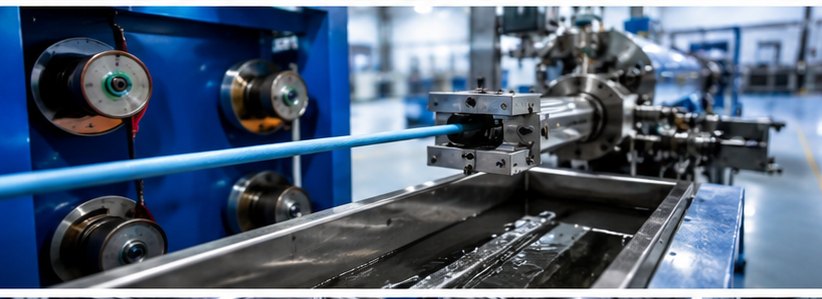
Ask a cable-plant engineer where quality problems and output limits usually trace back to, and a surprising number of answers point to the same place: the screw and barrel. It is the heart of the extruder — the part that melts the polymer, mixes it and pumps it to the crosshead at a steady pressure. Choose it well and the line runs sweet; choose it badly and you fight inconsistency forever.
What the screw and barrel actually do
The barrel is a heated steel cylinder. Inside it, a precision-machined screw rotates, and three things happen along its length:
- Feeding — solid polymer (pellets or powder) is conveyed forward from the hopper.
- Melting (compression) — the screw channel gets shallower, squeezing and shearing the material against the hot barrel until it melts.
- Metering — the now-molten polymer is pumped forward at a stable, even pressure toward the crosshead.
A good screw does all three cleanly, delivering a homogeneous melt at a consistent temperature and pressure. That steadiness is what the crosshead needs to make even, concentric insulation.
L/D ratio: the first number to check
The L/D ratio — the screw’s length divided by its diameter — is the headline spec. Cable extruders commonly run anywhere from around 20:1 up to 25:1 or more.
- A longer screw (higher L/D) gives the polymer more residence time to melt fully and mix, generally improving melt quality and output.
- A shorter screw is more compact but has less room to homogenise, which can limit throughput or melt uniformity.
There is no universal “best” — it depends on the material and the product. The point is that L/D is a deliberate design choice, not an afterthought. (We cover the concept in more depth in our note on what L/D ratio means.)
The polymer decides the screw
Cable work spans very different materials, and each wants a different screw geometry:
- PVC — shear-sensitive and heat-sensitive; it wants a gentle, well-controlled screw that won’t scorch it.
- PE and XLPE — need thorough melting and good pressure stability for insulation-grade quality.
- Rubber/elastomers — often run on entirely different, cooler screw designs.
A screw optimised for PVC will not be ideal for PE, and vice versa. This is why plants running multiple materials often keep more than one screw, or specify a design that balances their real product mix. Matching the geometry to the polymer is exactly the kind of decision that well-engineered screw and barrel sets are built around — feed, compression and metering zones proportioned for the material the line will actually run.
Wear, bimetallic barrels and life
Screws and barrels wear. The clearance between them opens up over time, and as it does, output and pressure stability drop. Two things fight this:
- Hardened or nitrided screws resist abrasion.
- Bimetallic barrels — a hard alloy liner fused inside the barrel — dramatically extend life, especially with filled or abrasive compounds.
For a production plant, barrel and screw life is an economic decision, not just a technical one: a bimetallic barrel costs more up front and pays back in years of stable output.
The practical checklist
When specifying a screw and barrel for a cable line, work through:
- Which polymers will it run, primarily?
- What output (kg/h) is the line targeting?
- What L/D suits that material and output?
- What wear protection does the compound demand?
Answer those honestly and the right screw-and-barrel pairing usually becomes obvious. Get it right and the rest of the line — crosshead, cooling, haul-off — has a stable melt to work with, which is the foundation of consistent cable.